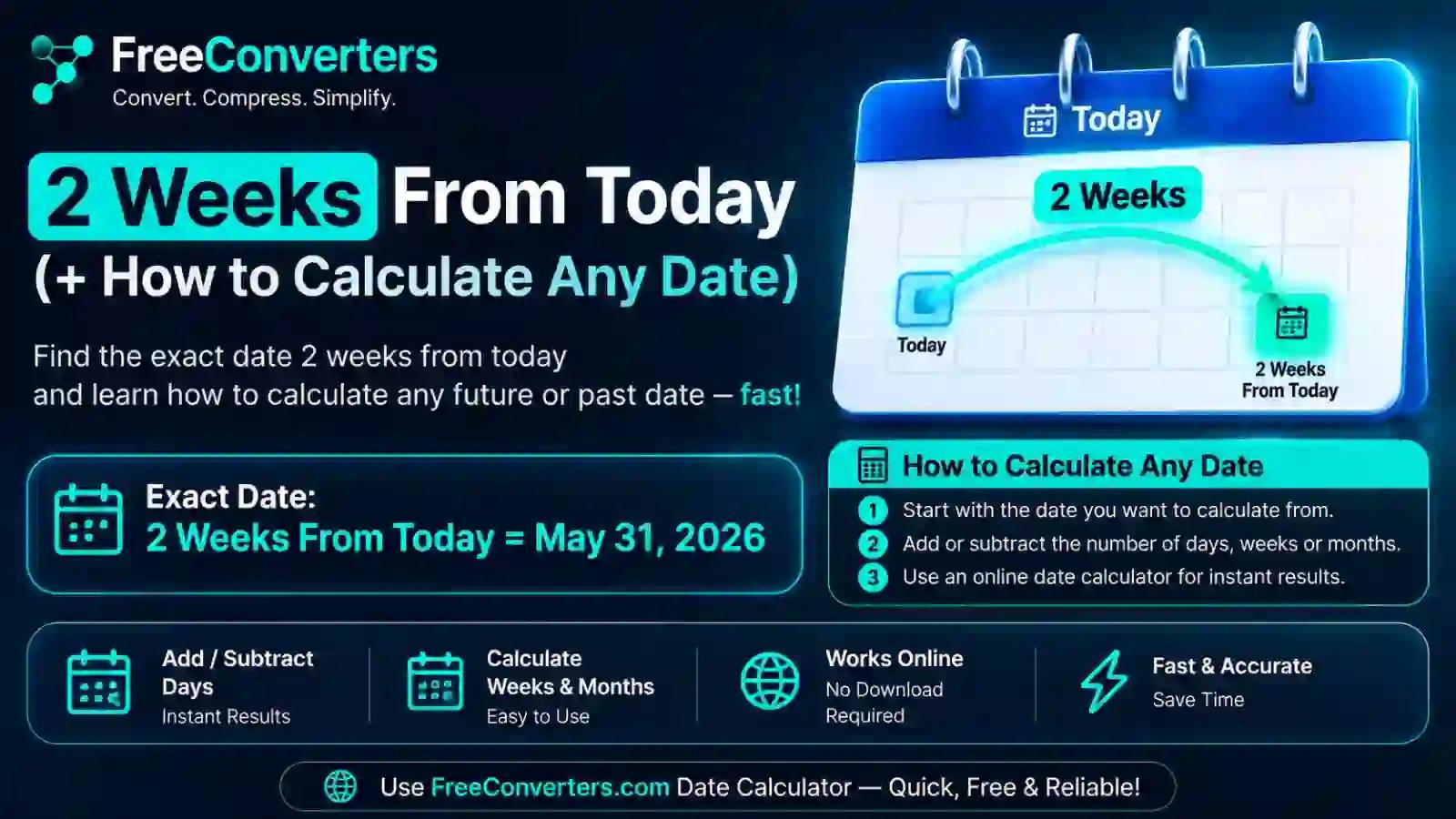
2 Weeks From Today: Date Calculator & Exact Date (2026)
If today is Wednesday, August 19, 2026, then two weeks from today falls on Wednesday, September 2, 2026. That's exactly 14 calendar days ahead, landing on the same weekday you started on, since 14 is a clean multiple of 7.
If you're reading this on a different day, don't worry — the math stays the same. Add 14 to today's date, and if you cross into a new month, subtract however many days remain in the current month to figure out how far you spill into the next one. Later in this guide, you'll find the exact formula, a few shortcuts, and a breakdown of when "2 weeks" doesn't actually mean what people assume it means (hint: it depends on whether you're counting calendar days or business days).
Quick Reference Table: From Today to the Near Future
Since "2 weeks from today" is rarely the only date someone's trying to figure out, here's a quick table covering the most searched timeframes, calculated from Wednesday, August 19, 2026.
Timeframe Days Added Resulting Date Day of Week 1 week from today 7 days August 26, 2026 Wednesday 2 weeks from today 14 days September 2, 2026 Wednesday 3 weeks from today 21 days September 9, 2026 Wednesday 1 month from today ~30 days September 19, 2026 Saturday 10 business days from today 14 calendar days (2 weekends skipped) September 2, 2026 Wednesday
Notice something interesting in that last row — 10 business days and 2 calendar weeks land on the same date here, but that's a coincidence tied to this specific starting weekday. We'll unpack why business-day math shifts depending on where in the week you start.
What Does "2 Weeks From Today" Actually Mean?
"Two weeks from today" is a form of relative date calculation — you're taking a fixed reference point (today) and projecting forward by a defined interval (14 days). It sounds simple, and mathematically it is, but the phrase gets used in a surprising number of real-world contexts where the "correct" answer changes depending on intent:
- A landlord or employer saying "give two weeks' notice" almost always means 14 calendar days, not 10 working days.
- A doctor's office scheduling a "two-week follow-up" usually means calendar days too, unless they specify "10 business days."
- A contractor or vendor quoting "2 weeks for delivery" might actually mean business days, especially if they explicitly exclude weekends in the fine print.
This is why any decent date calculator — and any decent article about one — needs to separate calendar-day math from business-day math instead of treating them as interchangeable.
How to Calculate 2 Weeks From Today Manually
You don't need a tool to figure this out. Here's the exact method, broken into three approaches depending on how comfortable you are with mental math.
Method 1: Simple Date Addition
- Start with today's date: August 19, 2026.
- Add 14 to the day number: 19 + 14 = 33.
- Since August only has 31 days, subtract 31 from 33, giving you 2.
- Move to the next month: September 2, 2026.
This "overflow" method — subtracting the days in the current month once your total exceeds it — is the core trick behind all manual date addition. It works the same way whether you're adding 14 days, 40 days, or 6 months.
Method 2: Counting by Weeks
Since 2 weeks equals exactly 14 days (2 × 7), and a week always returns you to the same day of the week, you can shortcut the math:
- Find the date exactly 1 week away first (add 7).
- Add another 7 to that result.
- You'll land on the same weekday both times.
Using today's example: August 19 (Wednesday) → August 26 (Wednesday) → September 2 (Wednesday). This weeks-to-days conversion trick is useful any time you're adding multiples of 7, whether that's 2 weeks, 3 weeks, or 10 weeks.
Method 3: Using a Calendar App or Online Tool
If you'd rather skip the arithmetic entirely — especially useful when the calculation involves leap years, month-end edge cases, or business-day exclusions — a free online date calculator does this instantly. You type in a start date and an interval, and it returns the exact resulting date along with the day of the week, without you having to track month lengths or leap years yourself.
Calendar Days vs. Business Days: Why the Distinction Matters
This is the part most date calculators skip, and it's exactly where people get tripped up. Calendar days count every single day, including Saturdays, Sundays, and public holidays. Business days (also called working days) only count Monday through Friday, and often exclude recognized holidays too.
Here's how the two diverge starting from Wednesday, August 19, 2026:
14 calendar days → September 2, 2026 (a straight 2-week count, no exceptions)
14 business days → this stretches across roughly 3 calendar weeks, because you skip 4 weekend days along the way, pushing the actual date to around September 8, 2026
That's nearly a week of difference between "2 weeks" interpreted as calendar days versus interpreted loosely as "10 working days" (which some people mistakenly call two weeks). If you're dealing with a contractual notice period, a shipping estimate, or a legal deadline, always clarify which type of day is being counted — it can be the difference between meeting a deadline and missing one.
A good rule of thumb: unless a document explicitly says "business days" or "working days," assume calendar days. Most everyday phrases like "see you in two weeks" or "the report is due in two weeks" default to calendar-day counting.
How to Calculate Any Date: The General Formula
Once you understand the logic behind 2 weeks from today, you can apply the same date arithmetic to any interval — 30 days, 90 days, 6 months, or even years. Here's the general approach:
- Identify your starting date and the interval. This could be adding (a future date) or subtracting (a past date).
- Convert the interval into days if it isn't already. Weeks × 7 = days. Months are trickier since they vary in length (28–31 days), so most people add months to the month number directly rather than converting to days.
- Add or subtract from the day number, rolling over into the next or previous month when you exceed the month's day count.
- Adjust for leap years if your calculation crosses into or through February. In a leap year, February has 29 days instead of 28, which shifts everything by one day if your range includes it.
- Cross-check the day of the week using the 7-day cycle — since every 7 days returns you to the same weekday, this is a fast way to sanity-check your math.
Leap Year Date Calculation
Leap years occur every 4 years (with a small exception: century years not divisible by 400 are skipped — 2000 was a leap year, but 1900 wasn't). 2026 is not a leap year, but 2028 will be. If you're calculating a date range that spans February 29 in a leap year, remember that month has one extra day, which can shift your final result by a day compared to a non-leap-year calculation.
Working With ISO 8601 and International Date Formats
If you're calculating dates for international business, scheduling, or software development, it helps to know the ISO 8601 date format (YYYY-MM-DD), which avoids the ambiguity of formats like 08/09/2026 — is that August 9th or September 8th? Under ISO 8601, September 2, 2026 is written as 2026-09-02, removing any regional confusion between US and international date conventions. This format is also what most databases, APIs, and spreadsheet tools use internally, even if they display dates differently to users.
Real-World Use Cases for "2 Weeks From Today"
The phrase shows up constantly in daily life, and the "right" way to calculate it shifts slightly depending on context:
- Giving notice at work. A standard two weeks' notice period is almost always calendar days — if you resign on August 19, your last day is typically September 2, not later.
- Deadline planning. Project managers often set milestones "2 weeks out" as a buffer for deliverables, using calendar days as the default unless the team explicitly works in sprints with defined business-day counts.
- Event planning. RSVPs, invitations, or vendor bookings due "in two weeks" almost always mean calendar days, since events don't pause for weekends.
- Medical follow-ups. A "two-week check-up" after a procedure is calendar-day based, tied to biological healing timelines rather than office schedules.
- Shipping and delivery estimates. This is the one category where business days are common — many carriers quote "10–14 business days," which, as shown above, can stretch noticeably longer than a straight 2-week calendar count.
Knowing which category you're in before you calculate saves you from showing up a week early — or worse, a week late.
Related Date Calculations You Might Need
Two weeks from today is just one slice of a much bigger set of date questions people run into regularly. A few related calculations worth bookmarking:
- Need a shorter window? Check out how to calculate 40 days from today for medium-range planning like visa processing or trial periods.
- Working backward instead of forward? See our breakdown of 90 days ago from any given date, useful for return policies and eligibility windows.
- For anything beyond a simple day count — including business-day exclusions, time zones, and custom intervals — the full date calculator tool handles it in one click.
- If your calculation involves coordinating across regions, pair it with a time zone converter so your "2 weeks from today" lines up correctly no matter where the other party is located.
Why Use an Online Date Calculator Instead of Doing It by Hand
Manual date math works fine for a single, simple calculation like 2 weeks from today. But it gets error-prone fast once you're dealing with:
- Multiple overlapping deadlines
- Date ranges that cross a leap year or month with fewer than 31 days
- Business-day-only counts with holiday exclusions
- Time zone differences when the other party isn't in your region
- Longer intervals like 6 months or several years out, where mental math becomes unreliable
A dedicated date calculator handles all of these automatically, gives you the resulting date and weekday instantly, and removes the guesswork around leap years or month-length variations. It's especially useful if you're calculating dates repeatedly — HR teams tracking notice periods, project managers tracking milestones, or anyone juggling multiple deadlines at once. You can also explore the full suite of tools for related calculations like time duration, currency conversion, and file conversion, all built to save you the manual work.
Frequently Asked Questions
What is the date 2 weeks from today? As of Wednesday, August 19, 2026, two weeks from today is Wednesday, September 2, 2026. Since 14 days is exactly two full 7-day cycles, the resulting date always falls on the same day of the week you started on.
How many days are in 2 weeks? Two weeks equals exactly 14 days. This is a fixed conversion — 1 week always equals 7 days, so multiplying by 2 gives you 14, regardless of which month or year you're calculating from.
What day of the week is 2 weeks from today? It's always the same weekday as today, since 14 is evenly divisible by 7. If today is a Wednesday, 2 weeks from today is also a Wednesday — this holds true no matter what the actual date is.
How do I calculate business days instead of calendar days? Count forward day by day, skipping Saturdays and Sundays (and holidays, if relevant). Starting from a Wednesday, 14 business days typically lands about 3 calendar weeks out rather than exactly 2, because you're skipping 4 weekend days along the way.
How do date calculators handle leap years? A properly built date calculator automatically checks whether any February in your date range falls in a leap year (like 2028) and adds the extra day (February 29) if needed. This matters most for longer calculations — a straightforward 14-day addition like this one is short enough that leap years rarely affect it.
Can I calculate a date from a day other than today? Yes — the same addition method works from any starting date, not just today. Just replace "today" with your chosen start date and follow the same day-count and rollover logic explained above, or plug the date into an online date calculator for an instant result.
Final Takeaway
Two weeks from today — Wednesday, August 19, 2026 — lands on Wednesday, September 2, 2026, a clean 14-day jump that keeps the same weekday. The manual math is simple once you understand day-rollover and the weeks-to-days shortcut, but the real skill is knowing which 14 days you're actually counting: calendar or business. Misreading that distinction is where most scheduling mistakes happen, whether it's a notice period, a shipping estimate, or a project deadline.
If you're calculating dates often — for deadlines, notice periods, or planning — bookmark the free date calculator so you don't have to redo this math by hand every time. It's built to handle calendar days, business days, and longer ranges in a single search.